

Ask me what to do in the medina after dark and my answer is short. Slow down. Let the city come to you. The evening is when Marrakech stops performing for the crowds and starts being itself.
The best things to do in the Marrakech medina at night are simple. Watch Jemaa el-Fnaa square come alive with storytellers, musicians and food stalls. Have dinner on a rooftop above the old town. Take a guided food tour through the alleys after dark. Walk the quiet derbs once the day-trippers have gone. End the night in a candlelit riad. None of it needs a rigid plan. Most of it improves without one.
I’ve lived here long enough to stop counting. And I still walk out into the medina at night on instinct. Here’s how I’d spend an evening if you gave me one.
Jemaa el-Fnaa: the square after dark
Start with the heart of it. Jemaa el-Fnaa is the great square of Marrakech. By day it’s busy. By night it becomes something else entirely.
The sun drops. The lights come on. Rows of numbered food stalls appear as if from nowhere. Smoke rises off the grills. The whole square turns into one enormous open-air kitchen. This is a UNESCO-listed space, and its evening ritual has barely changed in centuries.
Is Jemaa el-Fnaa worth visiting at night? Yes. Absolutely. It’s touristy and completely real at the same time. Locals eat here too. You’ll find grilled meats, snail vendors, fresh orange juice and sticky pastries. Order something simple. Sit on a bench. Watch the square work.
The real magic is the animation. Gnaoua musicians play in tight circles, drums and metal castanets ringing into the night. Storytellers — the halqa — hold crowds spellbound in Arabic, hands moving, voices rising. Snake charmers, henna artists and acrobats fill the gaps. It’s noisy, chaotic and unforgettable.
My advice is to give it an hour. No more. Soak in the energy. Then leave before it tips over into too much. The square is best as an opening act, not the whole evening.
Go up: the rooftops of the medina
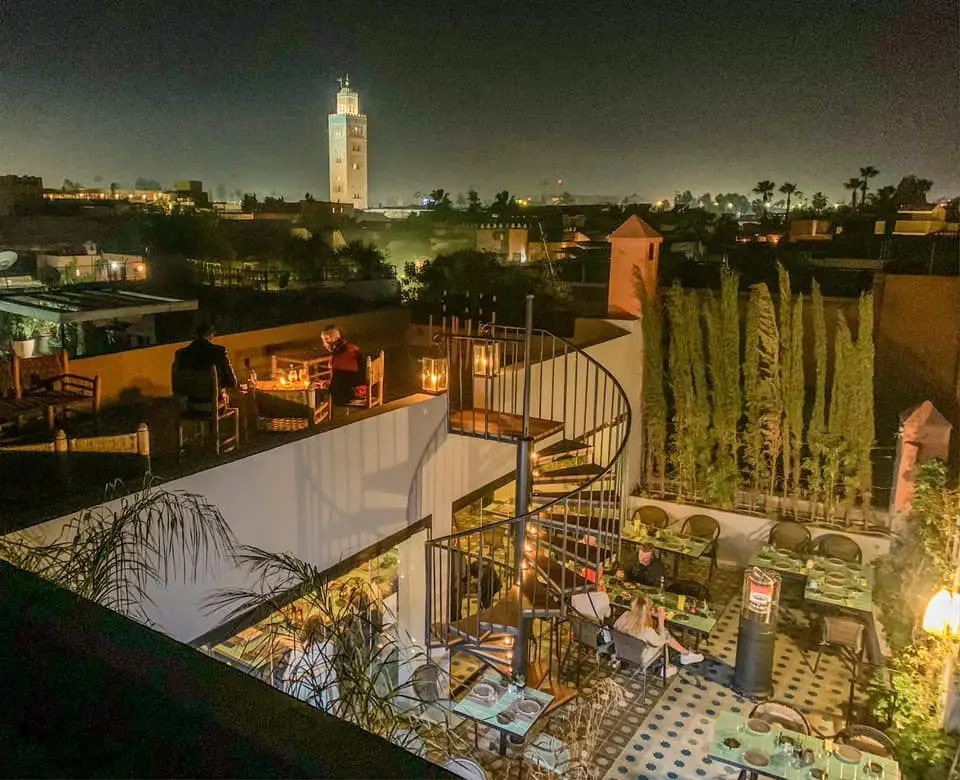
Once you’ve had the square, get off the ground. This is where Marrakech quietly shows its best face.
The medina reads completely differently from above. The rooftops stretch out in every direction. The Koutoubia minaret glows gold. The call to prayer moves across the city in waves. On a clear evening, the Atlas Mountains sit dark on the horizon behind it all.
Where are the best rooftops in the Marrakech medina? A few names I’d send anyone to. Lmida is my top pick — a stylish rooftop right on the edge of Jemaa el-Fnaa, with a direct view over the square and the Koutoubia beyond. Nomad sits in the old spice market, modern Moroccan food on a terrace that catches the sunset perfectly. Terrasse des Épices, a few steps away, is a long-standing favourite with one of the most relaxed rooftop settings in the medina. All three sit within Mouassine and the streets around Jemaa el-Fnaa, so you can move between them on foot.
Beyond the well-known spots, the best terraces belong to the riads — hidden from the street, invisible on any map, and often the finest of all.
Timing matters more than the address. Sunset is the obvious moment. But the hour just after is the one most people miss. That’s when the sky turns from orange to deep Marrakech blue. The terraces fill. The temperature drops to perfect.
Here’s the honest version. A public rooftop at sunset means sharing it with a crowd. A private one means the whole terrace is yours. A table set as the light goes. Nobody at the next chair. That’s the difference between watching the sunset and having it — and it’s exactly the kind of evening worth arranging in advance.
Food tours: eating the medina with a guide
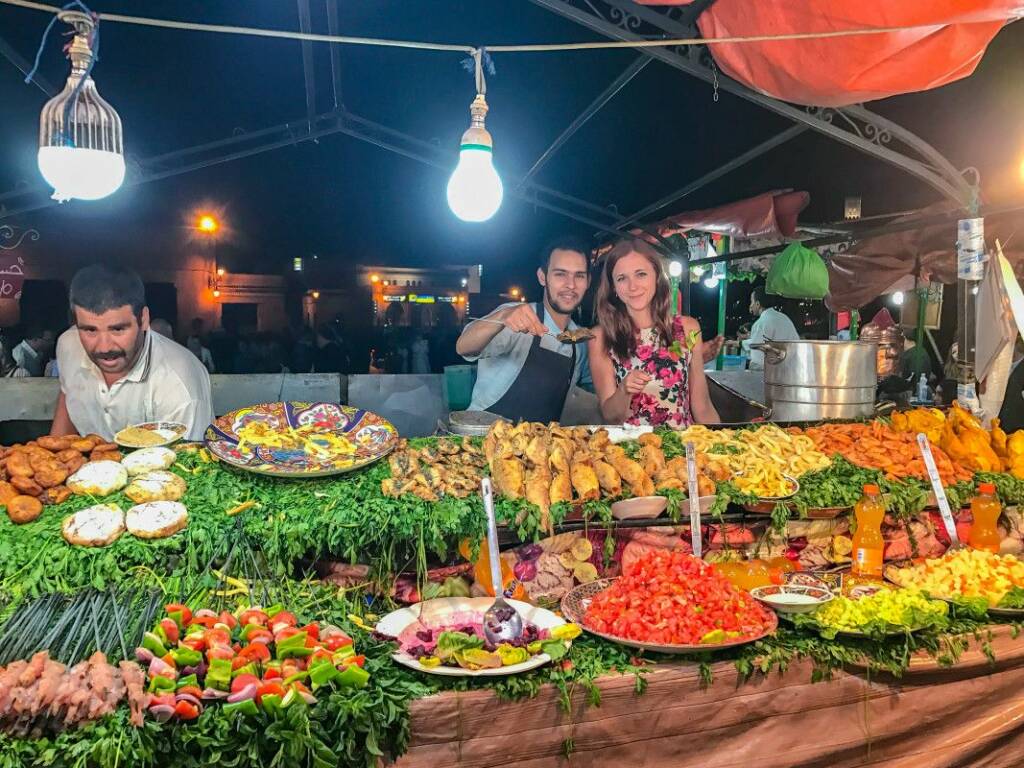
The single best way to understand Marrakech at night is to eat your way through it with someone who knows where to stop. A guided food tour turns dinner into a discovery.
Why take a guided food tour instead of exploring alone? Two reasons. First, the food. The best stalls aren’t the ones facing the square. They’re tucked down side streets, feeding locals, invisible to anyone without a guide. Second, the alleys. The medina folds back on itself in ways that defeat a phone map. A guide walks you straight to the good part.
A proper evening food tour moves at a gentle pace. You graze rather than sit down to one big meal. Expect a few classic stops along the way. Warm bowls of harira soup. Msemen, the flaky griddle bread, torn straight off the pan. Tanjia, the slow-cooked Marrakchi speciality. Grilled skewers eaten standing up. Mint tea poured from a height. Maybe a sweet finish of chebakia or sfenj.
The route is half the pleasure. You duck through the derbs between bites. Your guide points out a spice stall, a hidden fondouk, the doorway of a working bakery where the whole neighbourhood brings its bread. You taste the city and read it at the same time. By the end you’ve eaten well and actually understood where you are.
For a first night in Marrakech, I recommend this over almost anything else. It’s the fastest way to feel the medina from the inside.
Walk the quiet derbs
After the food and the noise, do one more thing. Wander.
By day the medina is a contact sport. By night — real night, after nine or so — whole quarters fall silent. This is the version people came here imagining.
Mouassine is one of my favourites for this, around the old fountain and the fondouks. The Kasbah district near the Saadian Tombs works too. So do the lanes threading off Dar el Bacha. The shops are shuttered. The lamps are low. A cat sleeps on a doorstep. A door sits open onto a courtyard you weren’t meant to see.
Is the Marrakech medina safe at night? Generally, yes — in the way any old city is safe. Busy streets are easy. Empty ones take a little confidence. And the alleys genuinely do get confusing after dark. If it’s your first time, walking with someone who knows the turns isn’t about danger. It’s about looking at the city instead of at your screen.
End the night in a riad
There’s one more version of dinner, and for most of the travellers I look after, it’s the one they remember.
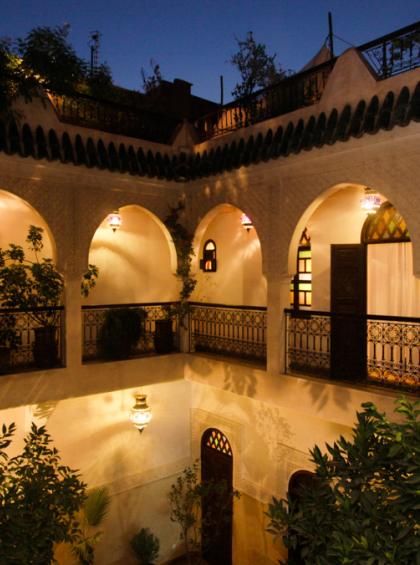
Picture a riad courtyard open to the sky. Candles in the alcoves. A table set for you alone. A menu that took the whole afternoon to prepare. Maybe the meal moves up to the terrace, the medina spread out below.
Where should you have a special dinner in the medina? Le Jardin and Dar Yacout are names I trust for a courtyard setting, and there are quiet riad tables I’d point you toward depending on your taste. This is Moroccan hospitality as it’s actually meant to be. Unhurried. Generous. A little ceremonial. The perfect close to a medina night.
The doors that don’t open to everyone
Now let me be straight with you. The best of the medina at night isn’t on any map. And you can’t book it from a search bar.
An artisan opens his workshop after hours — because you were introduced properly. A private courtyard concert. A hammam reserved for the evening. A dinner in a historic riad that never takes walk-ins. These are the nights people fly across the world for. They happen through people, not platforms.
That’s the whole secret of Marrakech after dark. The city rewards whoever knows a door, a name, a turning. Everything else — the square, the rooftops, the food tour, the long dinner in a courtyard — you can and should do yourself. But the medina keeps its best rooms for the introduced.
A simple plan for one perfect night
Put it together and an ideal medina evening looks like this. Start on a rooftop for sunset. Drop into Jemaa el-Fnaa for an hour of music and storytellers. Take a guided food tour through the alleys. Walk the quiet derbs to let it settle. Finish late over mint tea in a riad courtyard.
That’s the city at its best. Traditional, alive, a little secret. Exactly as it should be.
Frequently asked questions
What time does the medina come alive at night?
Things build from sunset onward. Jemaa el-Fnaa peaks between roughly 8pm and 11pm, when the food stalls, musicians and storytellers are all in full swing. The quiet derbs are best after 9pm.
Is it safe to walk the Marrakech medina at night?
Yes, with common sense. The main squares and streets stay busy and easy. The narrow back alleys get confusing after dark, so a first-time visitor is better off with a guide — less for safety than for not getting lost.
Do I need to book a rooftop or a food tour in advance?
For the popular public terraces, no. For a private rooftop, a guided food tour, or a table at a sought-after riad, yes — the best options fill up and some don’t take walk-ins at all.
Which rooftops have the best view of Jemaa el-Fnaa?
Lmida sits right on the square with a direct view over it and the Koutoubia. Nomad and Terrasse des Épices, both in the nearby spice market, offer wide rooftop panoramas over the medina rather than the square itself.
How long should I spend in Jemaa el-Fnaa?
About an hour. Long enough to eat something, watch the gnaoua musicians and feel the energy. Then move on before it becomes overwhelming.
What’s the best first night in Marrakech?
Sunset on a rooftop, an hour in Jemaa el-Fnaa, a guided food tour through the alleys, then a late dinner in a riad. It covers the tradition, the flavour and the calm in one evening.
Morocco Luxury Highlights arranges private evenings in the Marrakech medina for travellers who’d rather be shown the city than shown around it. Rooftops held for the night. Guided food tours with the right people. Riad tables reserved, and the doors that don’t open to everyone opened. Tell us the evening you have in mind.
